Spotlighting the people shaping Dev-Afrique’s work across Africa
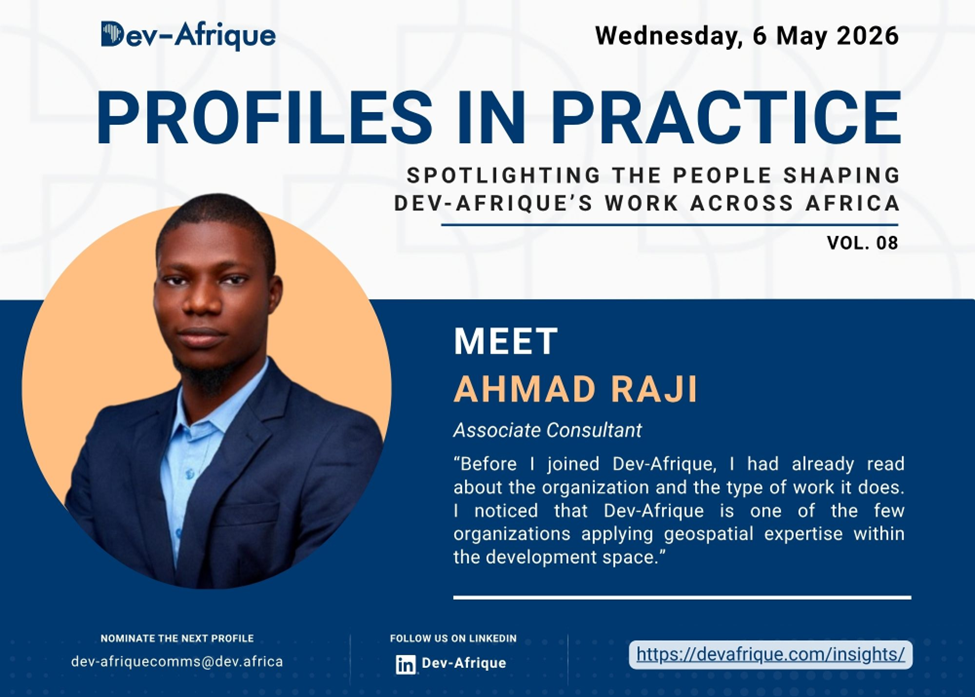
Ahmad Raji is an Associate Consultant at Dev-Afrique, where he specializes in geospatial data systems and analytics. With a background in Surveying and Geoinformatics, Ahmad works at the intersection of data, technology, and development, applying spatial analysis to help address complex challenges in sectors such as health and agriculture.
Since joining Dev-Afrique in October 2024, he has contributed to projects like Kimble, supporting polio vaccination campaigns in Nigeria, and the Agriculture Learning Series, which strengthens the deployment of AI solutions for small-scale agricultural producers.
In this conversation, Ahmed reflects on the interdisciplinary nature of geospatial development advisory, the behind-the-scenes work that makes data actionable, and the values that guide Dev-Afrique’s approach to sustainable impact.
Tell us About your education and professional background, and current role at Dev-Afrique
My name is Ahmad Raji. I have a Bachelor’s degree in Surveying and Geoinformatics from Obafemi Awolowo University, Nigeria. I am also currently undergoing training to become a registered land surveyor.
My background is in geospatial science. At Dev-Afrique, I work as an Associate Consultant, where I specialize in data systems within the geospatial practice area.
I joined Dev-Afrique in October 2024 as an analyst, and I have now been with the organization for about one year and five months.
What first drew you to the world of development advisory?
The first thing that drew me to development advisory work was the desire to create meaningful impact.
Originally, my experience involved delivering proposed solutions without necessarily following through on implementation. Development advisory provides the platform to ensure that solutions are not only proposed but are also sustainable and implemented effectively.
Another factor is that geospatial technology is still not fully utilized in Africa. Although it is growing, there is still a lot of untapped potential. Geospatial data is very versatile and cuts across many disciplines.
Everything happens somewhere, and because of that, geospatial analysis is highly applicable in development consultancy. The interdisciplinary nature of geospatial work aligns well with development advisoryand allows me to use my expertise to ensure that solutions translate into sustainable impact.
What let you to join Dev-Afrique Specifically, and how has your journey been so far?
Before I joined Dev-Afrique, I had already read about the organization and the type of work it does. I noticed that Dev-Afrique is one of the few organizations applying geospatial expertise within the development space. That immediately caught my attention. I was curious about how that expertise was being used and how I could contribute.
Since joining the organization, I have realized that problem-solving goes beyond analytics. You need stakeholder engagement, coordination, and behavioral change to ensure that solutions are sustainable.
Dev-Afrique has taught me that development work goes beyond sitting in the office. You need to go out, speak with people, connect with stakeholders, and ensure that the solutions you provide are implemented and used effectively. That experience has significantly shaped my professional perspective.
Can you describe a project at Dev-Afrique that has deeply impacted you?
I have worked on two projects that stand out for me.
The first is the Kimble Project, particularly the technical delivery workstream where we provide geospatial analytical support to the polio vaccination campaign in Nigeria. A key part of our work is ensuring that the vaccination campaign reaches the last mile, making sure that every child is vaccinated and supporting efforts to interrupt the spread of the polio virus.
We apply spatial analytics to identify locations where children may not have been vaccinated and to analyze areas where the virus could potentially spread through surveillance data.
One area I worked on is emerging settlement analysis, where we identify newly formed or rapidly growing settlements. These settlements may not yet be included in official datasets, which means children in those areas could be missed during vaccination campaigns.
By identifying and validating these settlements, we help vaccination teams locate them and ensure that children living there are reached. It has been very impressive to see stakeholders adopt and use our methods. Our work has been recognized by different actors, and it is satisfying to see our analyses being used to inform real-time decision-making.
Seeing the impact of our work in real time and knowing that more children are being reached through vaccination efforts is very fulfilling.
The second project I have worked on is the Agriculture Learning Series.
In this project, we collaborate with DevGlobal and Athena to strengthen the Agriculture AI ecosystem. One of the challenges we identified is that Africa is lagging behind in the application of artificial intelligence for agricultural advisory services, especially for small-scale farmers.
Through this initiative, we are bringing together innovators in the AgAI space to collaborate and explore solutions.
Dev-Afrique’s role involves coordinating a multi-stakeholder platform that brings together AI developers, extension systems, governments, donors, and private sector actors. The aim is to support the responsible deployment and scalable adoption of localized AI solutions that can support small-scale farmers across Africa and Asia.
We have developed discussion papers, hosted dialogue series and conferences, and conducted interviews with industry professionals to validate our findings. We are currently facilitating a working group to help strengthen the ecosystem.
Both projects resonate with me because they focus on two critical aspects of human life: health and agriculture.
What skills have you developed while working at Dev-Afrique?
One key skill I have developed is understanding that problem-solving goes beyond providing recommendations.
At Dev-Afrique, I have been involved in the full process, from identifying problems to developing solutions and ensuring that those solutions are implemented effectively.
I have also had opportunities to present solutions to stakeholders, engage with different actors in the sector, and receive feedback and recommendations from experts in the field. That exposure has been very valuable in strengthening both my technical and professional development.
Is there a hidden part of your role that people might not realize is crucial?
Yes, a lot of work happens behind the scenes.
For example, when supporting vaccination campaigns, we conduct analyses such as emerging settlement analysis and missed children analysis. These processes involve extensive data cleaning, processing, and analysis.
Working with large datasets requires patience. Sometimes a single analysis can take several hours or even a full working day to run.
Because of this, we often test processes on smaller subsets of data first before running them on the full dataset. This helps ensure accuracy and prevent errors.
We also develop scripts and automated workflows to make the process faster and more efficient. Since vaccination campaigns are ongoing, stakeholders need timely insights that can inform real-time decisions.
While stakeholders often see the final results in dashboards, spreadsheets, maps, or presentations, a significant amount of technical preparation happens behind the scenes.
What distinguishes Dev-Afrique’s approach to development advisory?
One thing that stands out about Dev-Afrique is the diversity of expertise within the organization.
There are experts from different disciplines working across a wide range of sectors. This allows for more integrated and sustainable solutions.
Even if you specialize in a particular area, you are exposed to knowledge from other sectors and disciplines. That cross-disciplinary learning is very valuable and helps strengthen the quality of the work we deliver.
How would you describe the team spirit at Dev-Afrique in one word?
Positive.
There is a strong culture of encouragement in the organization. People are supportive and always willing to help. Even when something seems challenging, there is a shared mindset that solutions can be found.
What might your teammates be surprised to learn about you?
Many people might see me as someone who does not talk much and assume that I am very introverted.
However, once I get to know people on a personal level, I can be quite outgoing. In fact, in my family I am considered the most talkative person in the house. So depending on the level of familiarity, people might see different sides of my personality.
Can you share a moment that reaffirmed your passion for the work you do?
One moment that stood out for me was seeing improvements in the data from the polio vaccination campaigns we support.
Earlier in the year, some of the numbers we were seeing were quite concerning. But toward the end of the year, we started seeing clear and measurable improvements. Although there is still more work to be done, it was encouraging to see that our recommendations were being implemented and that they were contributing to positive outcomes.
Seeing experts review our work, provide feedback, and apply the recommendations during campaigns reinforced my confidence that the work I do is meaningful and impactful.
How has working at Dev-Afrique influenced your perspective on development work?
Working at Dev-Afrique has helped me understand that development work goes beyond providing analytical support.
It requires engaging with stakeholders, communicating solutions clearly, and supporting implementation to ensure that the recommendations translate into sustainable impact.
In on sentence, why are you proud to work at Dev-Afrique ?
Because we make real impact.