Spotlighting the people shaping Dev-Afrique’s work across Africa
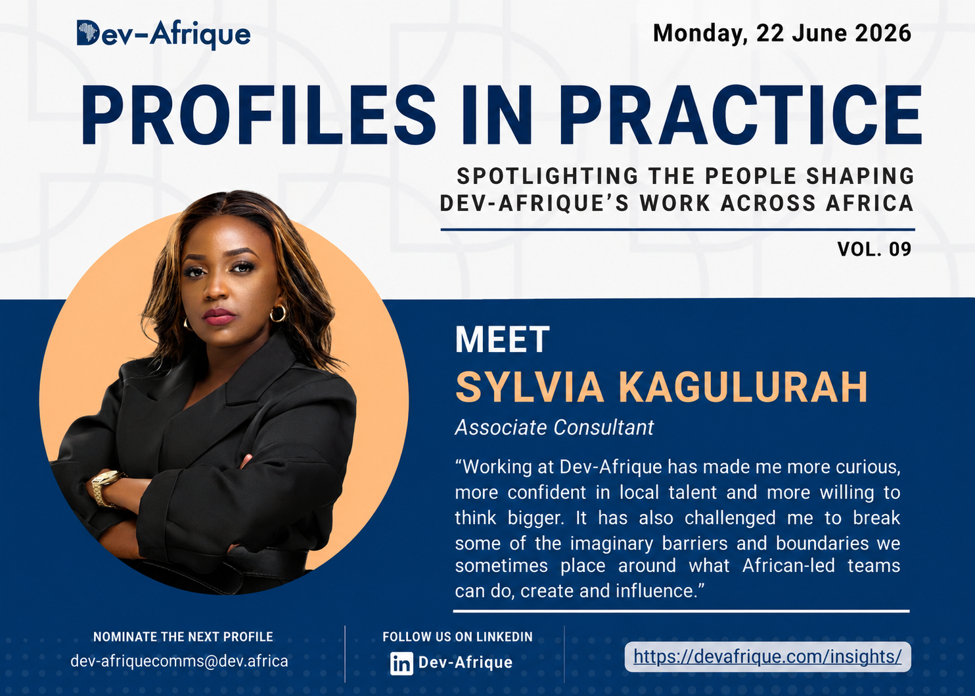
Sylvia Kagulurah is an Associate Consultant at Dev-Afrique with a background in project management, gender equality, disability and social inclusion, research, advocacy, and monitoring, evaluation and learning. With training in quantitative economics and ongoing studies in public health, she is particularly interested in the intersection of evidence, learning, and decision-making.
Since joining Dev-Afrique, Sylvia has contributed to projects spanning sustainability studies, data systems, and development advisory. Her work focuses on helping organizations and communities translate data and evidence into practical action and long-term impact.
In this conversation, Sylvia reflects on her professional journey, the role of data storytelling in development work, lessons from sustainability research, and the value of African-led approaches to solving complex challenges across the continent.
Tell us about your education and professional background, and your current role at Dev-Afrique.
I would start by saying: be careful what you wish for, because you just might get it.
My professional journey has largely been in the development space, with a focus on project management, gender equality, disability and social inclusion, research and advocacy. At some point, I found myself wanting to sharpen my existing skills and grow into what I like to think of as the “endline” of project management: monitoring, evaluation and learning.
When I came across Dev-Afrique, I was immediately drawn to the work the organisation was doing, especially through the Public Data Systems and MEL Practice. It felt like the right kind of challenge for me, given my background in quantitative economics, my interest in data systems and the fact that I am currently pursuing a Master of Public Health. The programme areas around GIS and health made the opportunity even more exciting.
Beyond the technical fit, Dev-Afrique stood out to me because it is African-led, ambitious and made up of a fairly young team with diverse talents and backgrounds. It honestly sounded like the African dream to me: a space where I could stretch myself, contribute meaningfully, learn and work on issues that are unique and relevant across the continent.
What first drew you to the world of development advisory?
I have always been drawn to work that sits between evidence and action. Development advisory work appealed to me because it is not just about identifying a problem, but also helping teams, institutions, and partners think through what can realistically be done about it.
I like the problem-solving side of it. I enjoy understanding the context, listening carefully to stakeholders, asking the right questions, and helping shape a pathway that is both ambitious and grounded. I am especially interested in advisory work that moves beyond reports and supports real adoption, implementation, and learning.
What led you to join Dev-Afrique specifically, and how has your journey been so far?
Professionally, I have been stretched in the best possible ways. Working at Dev-Afrique has made me more curious, more confident in local talent and more willing to think bigger. It has also challenged me to break some of the imaginary barriers and boundaries we sometimes place around what African-led teams can do, create and influence.
It has pushed me to polish my craft and become more intentional about the kind of professional I want to be. The work is fast-paced and demanding, but it also gives you room to grow if you are willing to learn, stay curious and step into new challenges.
Personally, it has reminded me to be the biggest cheerleader of my own efforts. It has taught me to recognise growth while still working towards bigger goals. More than anything, it has grounded me in the idea that your craft, your confidence and your goals all need consistent attention.
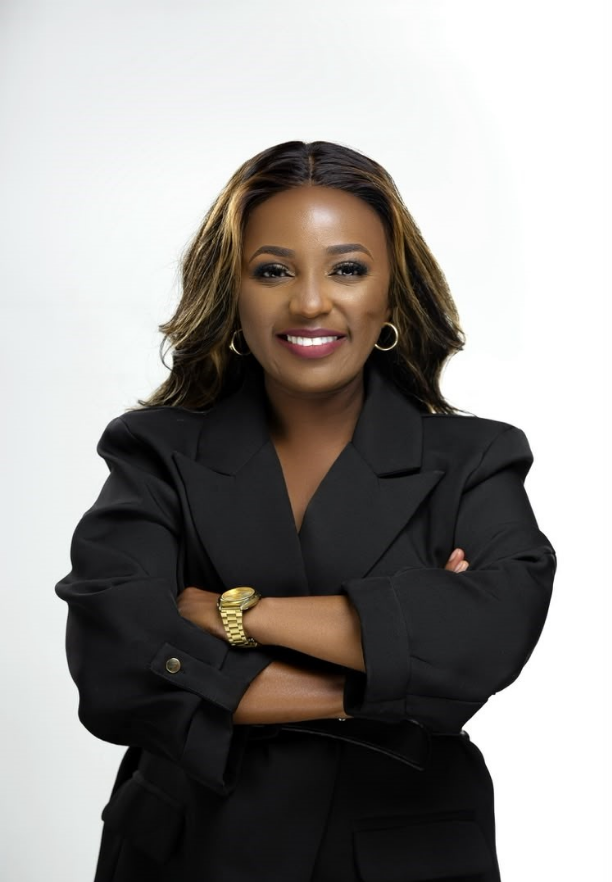
Can you describe a project at Dev-Afrique that has deeply impacted you?
The Hunger Project post-self-reliance sustainability study has really stayed with me. The assignment looked at what happens after communities have transitioned into self-reliance, which is such an important question in development work. It is one thing to design and implement a project, but it is another to understand what remains when the formal support has reduced or ended.
What made it meaningful was listening to communities speak about the changes that had lasted, the gaps that remained, and the ways people had adapted over time. It reminded me that sustainability is not just a technical term in a framework. It is about whether people can continue to organise, solve problems, access services, and improve their lives after a programme has come to a close.
Is there a hidden part of your role that people might not realize is crucial?
One part of my work that often happens behind the scenes, but is essential to making projects successful, is the translation layer, especially through data storytelling.
A lot of project work generates scattered building blocks: field notes, stakeholder conversations, indicators, partner updates, observations and lessons from implementation. On their own, these pieces can feel messy or disconnected. The real behind-the-scenes work is in organising them, identifying patterns, making sense of what they are really saying and turning them into something clear, useful and decision-oriented.
I like to think of it as moving from building blocks to a house. You start with raw materials, sort them, lay the foundation, build the structure and eventually create something people can actually use. In the same way, data storytelling helps move information from raw inputs to insight, from insight to learning and from learning to action.
For me, the value is not just in collecting data, but in making sure the data tells a story that teams, partners and decision-makers can understand, trust and use to strengthen programmes.
What distinguishes Dev-Afrique’s approach to development advisory?
Dev-Afrique does not feel like a traditional consultancy. There is an actual track record, but also a strong culture of doing the work properly, making sure the details are right, the thinking is clear, and the final output is useful. There is a level of discipline around quality that I really appreciate.
What also stands out to me is the way leadership is experienced. It is not only top-down. There is room for horizontal learning, brainstorming, and thought partnership, which makes it easier to grow, ask questions, and contribute meaningfully. That kind of environment matters because development work is complex and often requires collective thinking, not just individual expertise.
Honestly, I think we should consider developing a playbook because we may have just unlocked how to do development work the right way. There is something powerful about combining rigour, local expertise, practical delivery, and genuine thought partnership. That, for me, is what makes the approach distinct.
How would you describe the team spirit at Dev-Afrique in one word?
I would describe it as interesting, diverse, and quietly supportive. Working across countries has reminded me that, in many ways, we are the same people, just separated by language, borders, and context. That diversity is necessary because it gives us exposure, stretches how we think, and helps us tell the African story better.
The DA team shows up. It is not always loud or performative, but there is a subtle sense of ubuntu in how people support each other, review each other’s work, step in when needed, and keep things moving. The culture can be quite reserved in some ways, but the support is there, and you feel it in how the team works together.
What might your teammates be surprised to learn about you?
People might not immediately guess how much I see myself going into farming, especially through the lens of agri-tourism. Agriculture has always been part of my background, both from a family and educational perspective, but for a long time it felt like something I was quietly running away from because it was not always seen as exciting, modern or “hip.”
Now, I see it very differently. Agriculture is not just about production, it is also about livelihoods, food systems, culture, markets, women’s economic empowerment, sustainability and innovation. Through agri-tourism, farming becomes more than a source of food or income; it becomes an experience, a way of connecting people to land, local communities, traditional knowledge and the story behind what we consume.
It is definitely an area I see myself stepping into more seriously, both professionally and personally. I am especially interested in how agri-tourism can create dignified livelihoods, support smallholder farmers, promote local food systems and open up new opportunities for women and young people in rural economies.
Can you share a moment that reaffirmed your passion for the work you do?
Working on The Hunger Project study, from inception to its final phases, has really reminded me why this work matters. The process involved co-creation, thought partnership, and really thinking through what sustainability means beyond the life of a project.
It also reminded me that while numbers are important and, yes, numbers do not lie, qualitative work helps answer the deeper questions. It gives meaning to the data. It helps us understand the bigger ecosystem around the numbers, the why, the how, and the conditions that shape people’s experiences and perceptions.
For me, that is what makes the work stronger. It ensures that programming is not just evidence-driven on paper, but evidence-informed in a way that actually trickles into decisions, implementation, and learning.
How has working at Dev-Afrique influenced your perspective on development work?
Yes, it has reinforced for me that context is everything. Context, context, context. Development challenges cannot be understood or addressed using a one-size-fits-all approach. The systems, partnerships, politics, institutions, lived realities, and local knowledge all matter.
It has also made me appreciate how important partnership working is, especially with the shifts happening in the development space. Partnerships are the bedrock for navigating complex challenges because no single actor has all the answers.
Working across Africa has also reminded me that we need to tell the African story better. We have the data, but the real question is how we are using that data. Who is shaping the narrative? How are we translating evidence into learning, action, and better decision-making?
The learning process itself has been one of the most exciting parts. Some of the most valuable learnings are not predictable. They challenge assumptions and give a fuller picture of the issues, and that is what makes the work meaningful.
In one sentence, why are you proud to work at Dev-Afrique?
For me, being DA Proud means being part of a team that is helping build systems that are sustainable and that actually address real problems at the root. It means doing work that goes beyond ticking boxes and instead contributes to change that lasts.
It also means being thoughtful about how change happens. Development work should not disrupt existing structures and systems unnecessarily. It should understand what is already there, strengthen what is working, and support solutions that communities, institutions, and partners can carry forward.
That is what makes me proud to be part of Dev-Afrique. It is the idea that we are not just doing work for the sake of delivery. We are trying to do work that is useful, grounded, and capable of lasting beyond us.