Spotlighting the people shaping Dev-Afrique’s work across Africa
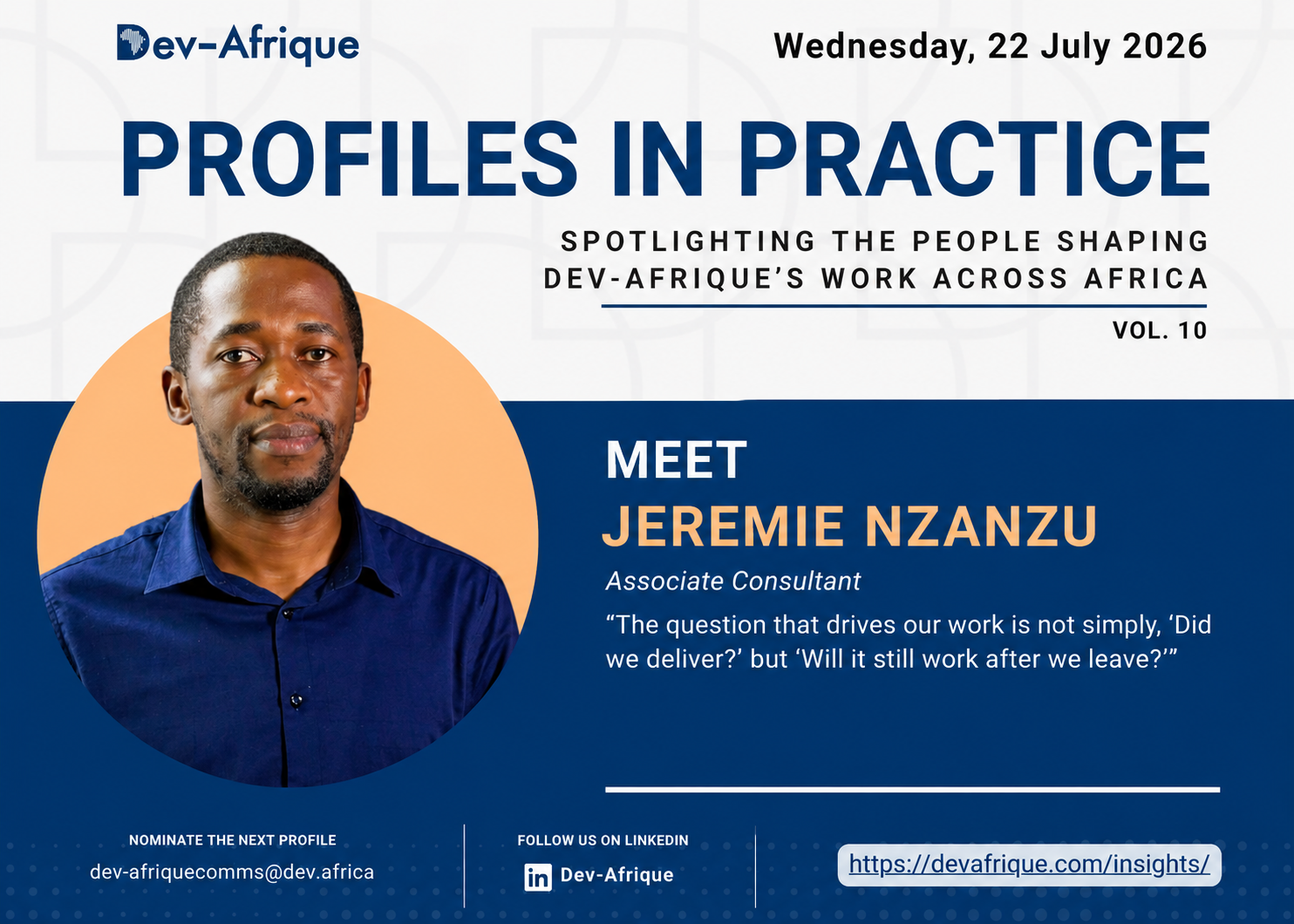
Jeremie Nzanzu is an Associate Consultant at Dev-Afrique with experience in public health, monitoring, evaluation and learning (MEL), health systems strengthening, research, programme coordination, and data systems. His work is centred on using evidence, systems thinking, and collaboration to support stronger institutions and more effective development outcomes.
Since joining Dev-Afrique, Jeremie has contributed to assignments involving strategy development, health systems strengthening, digital health, monitoring and evaluation, data use, and stakeholder engagement across several African countries. His work focuses on strengthening systems, improving coordination, and supporting evidence-informed decision-making.
In this conversation, Jeremie discusses his path into development advisory, the role of systems thinking in addressing complex development challenges, lessons from supporting health systems and digital transformation initiatives, and why he believes sustainable impact depends on what continues to work after an engagement has ended.
What path led you to your current role at Dev-Afrique?
My journey to Dev-Afrique has been shaped by a deep interest in solving real-world problems through evidence, systems thinking, and collaboration. I started by working across public health, research, monitoring and evaluation, data systems, and programme implementation, particularly in resource-constrained settings where the need for impact is high. (I should mention: very few people put “M&E Specialist” on their childhood vision board, but once you are in it, you realise you are essentially solving puzzles that actually matter, which turns out to be a surprisingly good deal.)
Over time, I became increasingly interested not only in implementation but also in understanding why programmes succeed or struggle, how evidence informs decisions, and how institutions can work better together. Experiences in programme coordination and leadership strengthened my interest in strategic thinking and systems strengthening.
What attracted me to Dev-Afrique was the opportunity to work across countries and sectors while contributing to solutions that genuinely matter. The work combines technical thinking with practical implementation, which resonates strongly with who I am professionally.
What first pulled you toward development advisory work?
What first pulled me in was seeing the gap between good intentions and actual outcomes. Across many African contexts, there are brilliant ideas and committed people, but implementation often struggles because of weak systems, fragmented coordination, or limited use of evidence.
I found myself naturally drawn to work that helps bridge those gaps, strengthening systems, helping institutions make better decisions, and ensuring programmes are designed with context in mind. Development advisory work gave me a space where analytical thinking meets practical problem-solving.
I also enjoy the learning aspect of this work. Every assignment brings a new challenge, and over time I’ve learned the importance of being adaptable, listening well, and balancing delivery with continuous learning.
Since joining Dev-Afrique, what has your experience been like both professionally and personally?
Professionally, it has been a very enriching journey and I use “enriching” in the fullest sense, not the development-sector version that quietly means “I read more Terms of Reference than most people read novels.” I have had opportunities to work on assignments spanning strategy development, health systems strengthening, MEL, data use, and stakeholder engagement across different countries and contexts. The experience has pushed me to think beyond immediate deliverables and focus on long-term impact.
Taking on additional coordination responsibilities has also stretched me in meaningful ways, strengthening my ability to adapt quickly, manage competing priorities, and build trust through communication.
Personally, the experience has taught me patience and perspective. Development work is rarely linear, and meaningful change often comes through consistent effort rather than quick wins. It has also reinforced the value of teamwork, mentorship, and continuous learning.
Is there a project or piece of work at Dev-Afrique that particularly stayed with you? What made it meaningful?
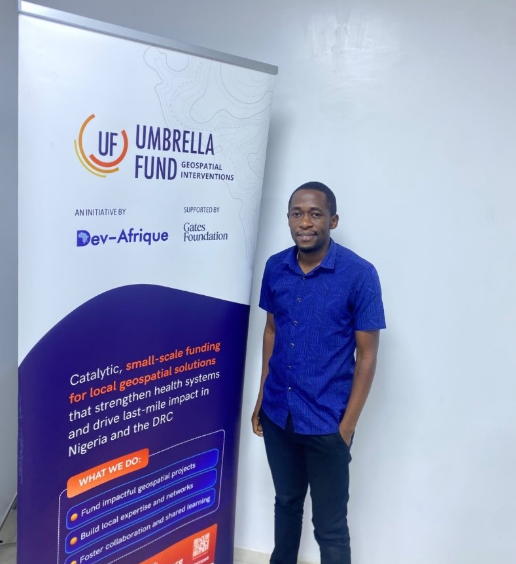
One project that has particularly stayed with me is the digital equipment inventory initiative in the DRC under the Umbrella Fund, an effort to address a persistent but often invisible challenge: health systems frequently lack a reliable, system-wide picture of where digital and biomedical equipment exists, what condition it is in, or how it is being used.
In the DRC, where multiple tools and platforms operate across government institutions, partners, and programmes, that fragmentation has real consequences for planning and service delivery. Working to establish a centralised inventory system, designed to be hosted and sustained by ANICNS as a national institution, meant contributing not just a technical tool but a stronger foundation for governance and decision-making.
That experience reinforced something I have come to appreciate throughout my work in health systems strengthening: behind every framework, strategy, or dataset are real people whose lives are ultimately affected by these decisions. Sometimes the most impactful work is also the least visible building the systems and coordination mechanisms that enable better decisions long after a project ends.
What is one part of your work that often happens behind the scenes but is essential to making projects successful?
One important aspect that often happens behind the scenes is stakeholder coordination and synthesis. A lot of work goes into listening, engaging different actors, reviewing data critically, and bringing multiple perspectives together in a way that creates alignment.
I’ve learned that trust and communication are often what make collaboration successful. Sometimes the most important contribution is ensuring that technical insights, field realities, and institutional priorities are all connected and moving in the same direction. If there were a SMART indicator for this, it might read: “Percentage of key stakeholders aligned and still speaking to each other by the end of the assignment.” So far, the numbers look encouraging.
From your perspective, what makes Dev-Afrique’s approach to development work distinct?
For me, one thing that stands out is the balance between technical rigor and contextual understanding. Dev-Afrique does not just approach challenges from a theoretical perspective, there is an effort to understand realities on the ground and work alongside partners in ways that are practical and actionable.
I also appreciate the emphasis on evidence-informed decision-making while recognizing that development work is deeply human and context-specific. There is space to think strategically while remaining focused on implementation and measurable outcomes.
What I think genuinely sets the organisation apart is what I would call the “un-consultancy” approach. Traditional consulting often follows a familiar pattern: arrive with pre-packaged solutions, deliver a report, and leave. Dev-Afrique takes the opposite approach: working with partners rather than for them, building systems that institutions can own, and measuring success not by the weight of a final deliverable, but by what continues long after the engagement ends. The guiding question is not simply, “Did we deliver?” but “Will it still work after we leave?”
How would you describe the culture or team spirit at Dev-Afrique?
I would describe it as collaborative, dynamic, and growth-oriented. People bring different strengths and experiences to the table while working toward a shared purpose.
What I value most is the openness to learning. Whether through mentorship, peer collaboration, or being trusted with new responsibilities, the environment encourages you to grow while knowing you are not doing it alone.
That spirit extends across Dev-Afrique’s presence in Nigeria, DRC, Kenya, Zambia, Burkina Faso, and beyond. There is a shared commitment to pace, purpose, and follow-through, often captured in the phrase “Onward with Urgency.” In my experience, that culture is reflected not only in how we work with partners, but also in how we support one another internally.
What is something people at work might not immediately guess about you?
People might not immediately guess that I genuinely enjoy a well-structured results framework. My friends outside development find this both baffling and slightly concerning. I have made my peace with it.
Beyond that, I enjoy reflecting on leadership, purpose, faith, and the bigger impact of the work we do. I am naturally analytical, but I also value listening, reflection, and personal growth. I enjoy connecting ideas, whether data, strategy, people, or systems, and thinking about how they come together to create meaningful and sustainable change.
Has there been a moment during your time at Dev-Afrique that reminded you why this work matters?
Yes, particularly during engagements where you meet stakeholders and programme teams working under difficult circumstances but remaining deeply committed to improving people’s lives.
Those moments remind me that behind every strategy, dataset, recommendation, or report are real communities. They reinforce that our work is not only technical, it has human significance.
There have also been moments when being trusted with greater responsibility reminded me that leadership is ultimately about service and adding value wherever you are placed.
Has working at Dev-Afrique changed the way you think about development challenges and opportunities across Africa?
Absolutely. It has made me both more optimistic and more realistic.
I have come to appreciate how complex development challenges are, there are rarely simple solutions. At the same time, I have seen firsthand the innovation, resilience, and expertise that already exist across African institutions and communities.
The biggest shift has been recognising that sustainable progress comes from strengthening systems, investing in local capacity, improving coordination, and using evidence intentionally rather than relying on short-term fixes. I have also become a firm believer in the value of a good buffer in project timelines, workplans, and especially stakeholder meeting agendas. Any development professional who has sat through a “quick sync” that somehow lasted three hours will know exactly what I mean.
What does being “DA Proud” mean to you personally?
Being “DA Proud” means contributing to work that is purposeful and grounded in impact. It means being part of a team that values excellence, learning, trust, and practical solutions to complex challenges.
Personally, it means being trusted with opportunities that stretch me, learning continuously from colleagues and mentors, and contributing to something larger than myself.
Above all, it means knowing that our work helps strengthen systems and improve outcomes across Africa. That is something worth being proud of.